Showing posts with label Wingtips. Show all posts

Wednesday, 14 March 2012

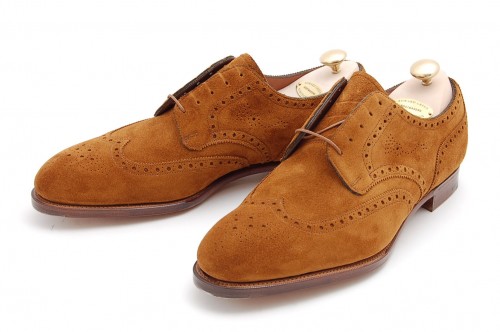
Today's Favorites - Bespoke Austerity Brogues


I have a friend who like me, once ventured outside of the US to go and study shoemaking (among other things, such as be with his wife...also like me). That adventure landed him in Germany, where he is currently residing and continuing to perfect his craft and skills, in the hopes (of which will occur) of becoming a bespoke shoemaker who offers lovely shoes to people around the world. On occasion, he gets a chance to pop over to London, of which he will usually stop in to have a chat, only this time, he brought a pair of shoes for me to also shine. While he is hard critic on himself (as one should be to become great) and feels that he is still far off from becoming a credited maker who could offer shoes to clients for purchase, I on the other hand, believe that he is not far off. The hardest part in shoemaking is what is called 'finishing' the shoe, i.e. making the sole and heel area look flawless, and it is something that takes a long time to perfect. And while he still has some work to do before it's tip top, I think that his progression is very good and wanted to show all of you, as I thought that some of you might appreciate it as well.....


Tuesday, 13 March 2012

What I Am Wearing


Before coming to England, I can wholeheartedly admit that I did not have a clue about suits and good tailoring. I used to even work in a place that sold (what I believed to be) nice suits but after seeing the quality of the cuts and tailors here on the Row (as we snobs like to call it), I now realize that what I used to see in the States was like a top sirloin from the grocery store and now I am dabbling in the Kobe beef from a 5-star restaurant. It's absolutely amazing what a good tailor can not only do for your figure, but for your whole image, and here at Gieves, we have someone who is rumored to be among the best and considering some of the things that I have seen him do, I don't doubt it! And in this new found passion of mine (whereby I am selling my personal shoes to buy more suits), I have come to love a nice double-breasted suit. Something about it just really appeals to me even though I am quite sure that I may not have the stature for them, as I am not the tallest of guys. Nevertheless, I don't care and will continue to pick up more and more of them, in every color I can! I must admit though, that my next order of suiting, is unfortunately not a DB, but rather a lovely navy flannel, peak lapel, single button suit and I can't wait to get it!!

Shoes: J.FitzPatrick design, Gaziano & Girling produced
Suit: Gieves (older label)
Shirt: TK Maxx
Tie: Robert Talbott, Best Of Class


Monday, 15 August 2011

Shoes -- Part 2: Style Names & Terminology -- Brogues


The term, brogue, is a word that can describe many many styles of shoe within the shoe realm. It is because of this that it is commonly misused and due to this misconception, I wanted to dedicate an entire post on brogues and what they really are. First off, let me start by saying that a brogue can be used to describe any shoe that has perforations in it (little holes). Because it ranges in such depth, you might find that the term can sometimes be confusing and attributed incorrectly. Therefore, let us begin the brogue education. The word brogue was first heard and used by the Scottish and the Irish in the late 16th century. But it was not until later that it became something that was used to describe shoes. As you may think of it now, a brogue in it's original use, also had holes in it, but they were actually functional, being that they used to drain the water that would get in a person's shoes, from walking across a wet terrain. Up until the early 1900's they were still considered a very casual shoe. It was not until later that they became what they are today: a super-hip dress shoe!

Full Brogues:

Full brogues, as shown above and directly below, are categorized by several things. First and foremost, they must have a wing-cap toe. Without this, it is not a full brogue, it will be called something else, of which I will get to below. The second thing is that you will find that full brogues will have each of the 5 pieces to the upper: cap, vamp, facing, quarter and counter (in case this is your first time reading, I described all of these here). It will always be the shoe with the most amount of perforations. Now, there are several shoes that may look like a full-brogue but will not be, because they won't have these 5 pieces, such as the Brummell shoe by Edward Green. While I find this shoe much more appealing than a full-brogue, it sadly is not considered one, as it does not consist of all of the necessary components to make it so. Full brogues, however, are in my opinion the most well rounded shoes in dress shoe history, as they can look good with everything, from suits to jeans. This is obviously subjective, but can easily be proven by putting together the proper outfits. Now this can be up for debate, but I was always under the impression that a full brogue needed to be an oxford and not a derby, which would therefore categorize the picture below the 2 directly under this writing to be a semi brogue. However, this I am not 100% sure about.


Semi Brogues (AKA Half Brogues):

Semi brogues are the full brogues cousin. They can look exactly like a full brogue except that they will have a cap toe (as opposed to a wing cap) and also have a medallion (decorative perforations) on the toe. This is a very common shoe in the business industry as a cap toe generally denotes a business setting. Obviously though, you won't find too many spectators, such as the one above, in the corporate environment. On that note, you will notice that a spectator, which is a style of shoe, can also fall under the brogue category as well as something else, like just calling it a cap-toe or a wingtip. All of these style names, as you can see, can sometimes be interrelated.


Quarter Brogues:

As you can somewhat see, the lesser down we go, the less perforations you will find in the shoe, and the more dressier the shoe will be. Quarter brogues seem to be far less common, at least from what I notice, especially in comparison to the full-brogue, which are among the most common of shoe styles. Quarter brogues are certainly not among the most stylish, when it comes to design, and maybe therefore this is the reason why I don't notice them as much. They dwell in appreciation of being simplistic and are therefore used as a conservative shoe for conservative occasions, such as working in the financial district. You will find that the majority of quarter brogues are going to have a cap toe. It will be uncommon for you to find a wing tip quarter brogue, as most designers seemed to be inclined to add all of the other pieces to the vamp when designing a wing cap shoe. But this is just my theory, let me grab my pen and paper and see how it actually looks! You will also notice that it must have not have a medallion on the toe, or else it becomes a semi brogue.


Longwing Brogue:

Ahh, the longwing brogue. This is the shoe most loved by Americans and American shoe companies. I was actually going to try and fill this entire post up with Edward Green's but just realized that of course, they don't a make a longwing brogue, at least not that I have ever seen. That being, I must give it up to the longwing master, Alden, as pictured below. The longwing derives it's name from the fact that the wing cap, instead of ending at the joints of the foot, extend all the way back to the heel, creating a long-wing-cap AKA longwing. You really don't see this shoe made too much outside of American shoe companies, with the exception of maybe trickers. I don't know why really? Maybe because they are generally made in a bulky fashion, but I must say that they can look good with a nice pair of jeans.


Top Two Pictures (directly above): Alden, Bottom Picture: Tricker's

All Other Pictures: Edward Green

Some Pictures Provided By: Leffot & Leather Soul

While there are many other shoes that have perforations on them, such as a monk brogue, it is pretty easy to understand what they might be labeled, or in actuality the fact that they might simply just fall under the casual title of 'brogue,' and truly not have a proper style name. Well, it's been a long one and I need to go and enjoy what's left of the sun, so until next time, enjoy the post!

Sincerely,

-Justin, "The Shoe Snob"


Monday, 18 July 2011

Shoes -- Part 2: Style Names & Terminology -- Oxfords


To get back to a little bit of education, I have decided to write my 'Monday long posts', on everything and anything referring to shoes, that being, the 'technical stuff' and giving a break to the aesthetic fluff that I usually put up. I first started with the different shoe constructions and am now moving on to the different style names and terminologies. As there is much to write, I will start with oxfords and proceed next week onto the following style: derby's (AKA bluchers). Enjoy!

Oxfords:

-- Wholecuts --

My favorite style of shoe is, hands down, the oxford. For me, it is the most elegant style out of everything a shoe/boot can become. This is because it allows, with it's closed lacing, the shoe to be very clean looking i.e. stitch free. The more stitch-free the shoe can become, the more elegant it gets, at least in my opinion. Oxfords can also be referred to as 'balmorals,' and this is due to the fact that oxfords were first seen in Ireland and Scotland, and thus takes after the name of the Queen of England's castle, which is also called Balmoral. But what you will always be able to use, in order to denote an oxford, is the fact that the tongue will always be stitched under the vamp.

As I was stating before, the most elegant (dressy) of all of the oxfords, is the wholecut (as shown above), due to the fact that it has no stitching across the main sections of the shoe (only the back seam). The beautiful version above is by French brand, Septieme Largeur.


Refer to these images above, for the names of the different pieces from the shoe's upper. Click on image to enlarge.


-- Plain Toe's --

While these shoe styles above are not technically called this, it is a good way to know what's on the next level of the hierarchy of dressiness. I have always felt that the less fluff that you see around the toe area, the dressier the shoe. This is partly because when wearing dress trousers, you tend to see mostly the toe area, and not the rest of the shoe. Therefore, the less stitching, the more elegant the model. As you will notice, however, on the top shoe, there is what is called a medallion, on the toe box. A medallion is brogueing (hole punching) in the shape of some symmetrical (unless bespoke) decoration that is positioned on the front of the toe box. This will be a matter of opinion, when deciding whether or not a medallion makes the shoe less dressy. I think that it does. That's not to say that it is not nice, but when considering what to wear to a formal event, less is always more. (The two beautiful models above by Anthony Delos)


 -- Cap Toe's --

A cap toe, or a straight cap, is denoted by the stitching that crosses over the toe box area. A cap toe is a very general term, much like wingtip, and can refer to any shoe that has a straight cap, such as this. And while this shoe shows all of the pieces of the upper, in a simple manner, I shall explain those as well, just in case the sketched pictures provided above, were a little confusing. The piece in between the cap and the laces, where your foot flexes, is called the 'vamp.' The little piece where the laces are, is called the 'facing.' The part where the heel is, is called the 'heel counter.' And last but not least, the leftover bit is called the 'quarter.'

You will find that the cap toe is probably the most popular model in dress shoe history. Since there have been suits, there have been cap toes, and it seems that they tend to go hand-in-hand, as most business professionals wear them. For many industries, this has become the staple model of dress shoe, which to me is unfortunate, as there are so many better models.

Model Above By: Anthony Delos


 -- Wingtips --

Wingtips, or wing caps, are just like cap toes, only they have this W shaped cap, as opposed to a straight line. Because of that shape, they are generally seen as less dressy, as this shape is "more daring," and less business-like. This is by no means my opinion, but rather what seams to be the elementary school of thought considered by many white collar industries, and their superiors. I can understand that it might be less formal, but in no way, does that make me feel that it is any less appropriate for business attire. But then again, things are changing and you will find that more people (thankfully) are wearing this style to work, with their business suits!

Shoes Above By: Gaziano & Girling


-- U-Caps --

Far less common, are the U-caps. This style, I believe, used to be used a lot more many years ago, by the likes of Edward Green and older shoe firms but has since been popular until recently. While it is still uncommon to see them, I feel that they will be making a come back in the near future. What's nice about them is that they add a breath of fresh air, to your closet, as they will stand out from all of the other common styles, that everyone owns. While I still do not have a pair, I am definitely going to be adding that to my 'must-have' list, and would not mind if they came from Laszlo Vass, as I love the one's that he did, pictured above.


-- Saddle Shoes --

If you have read my blog before, than you know a thing or two about saddle shoes, and how they are my absolute favorite style ever!! And as I have written a ton of info about them before, including here, I won't bore you with more mumbo jumbo. I will just say, that they never disappoint, and it is good to see them back on the books for many companies upcoming seasons.

Shoes Above By: Septieme Largeur


-- Galosh Shoe --

While this could be up for debate, I have heard this model called 'galosh style' before, as it looks as if there is a galosh covering the toe to heel area, leaving the facing and top of the quarter exposed. Yet, some people also refer to it simply as a balmoral. Whatever the case, it is proper style, one that I find quite appealing and elegant. I only wish that you would see it more, not only in stores, but also on people's feet!

Top Shoes: Craig Corvin
Bottom Left: Laszlo Vass; Bottom Right: Gaziano & Girling

Well, as it is late and I am super tired and therefore I am going to leave it at that for today. While there are so many more to go and you might have thought that I left some out, be patient and you will more than likely see them on another post, when I get to brogues, spectators, derby's, boots etc.

-Justin, "The Shoe Snob"

Wednesday, 29 June 2011

Today's Favorites - Saint Crispin's Part 2


It's tough knowing a brand, that you like a lot, and not being able to see them in the flesh without either buying a pair or flying to the country of origin to visit their showroom. Saint Crispin's, as well as many Japanese and French labels, fall into this category for me. That's the beauty of being a shoe buyer though. If you truly wanted, you could go out and find many up and coming brands that you felt had potential and put them into your store. What a great job! Although, everything sounds easier when spoken versus when taken into action. As Ryan said in the interview below, it's simply not about buying what you, the buyer, actually likes, but more what the mass market will like. In my opinion, that's the downside. Because the mass market tends to like a lot of rubbish and brands that make beautiful shoes, such as these, stay small and never grow out side of their continent and maybe even their country. Yet brands that make crap, like many of the Kurt Geiger products, become a country's biggest seller....and it's all because of one factor: Price.

Price is king.....unfortunately.


Thursday, 9 June 2011

Shoes Of The Week - Clark Throwbacks


The beauty of being on Savile Row and working in a store like Gieves & Hawkes is that you get to see and appreciate well-dressed gentleman on a daily basis. And while the majority of shoes I see them wearing are black, every now and then, I get a treat and stumble upon surprises, such as these Clarks shoes from 22 years ago.

Having sold shoes for a few years and many of them being Clarks, I have this vision stamped in my head of what a Clarks shoe should look like. You know, orthopedic looking with a rubber sole and such. So when the gentleman told me that these were Clarks, I just nearly had a heart attack for the bewilderment of knowing that they actually used to make stylish, well-made shoes. That was something I would have never thought, but now that I look at it is something that does not surprise me, as many companies today that have migrated towards mass-produced, mass-market shoes made in China, once used to be well-made shoes built on their own soil, such as Clarks and Johnston & Murphy. But, things change and now we can just appreciate the beauty of relics like these!

Wednesday, 11 May 2011

Today's Favorites - Church's Women's Collection


I walk by the Church's store, in Burlington Arcade, every morning and afternoon and am constantly impressed by their women's collection and always baffled by the men's collections. It's like they literally took all of the designer talent and put them onto the women's side of the company. On a constant basis there are always these uniquely fresh new styles on the women's side of the store, but on the men's side, it's the same 'ol boring, black and dark brown cap toes and penny loafers. I can understand that the classic black Church's shoe is a staple piece in the London working man's wardrobe, but a little bit of new designs and colorways would not detract from their image, at least in my mind, it would boost it! Because of that, and the fact that their women's shoes could pass as men's, I figured that I would share some of it with you. It's a shame that I could not find their newest model because it has been the best yet. It reminds me of a Paul Smith shoe really, in that it's classic (a cap toe) but also has it's modern twist by adding perforations throughout the entire upper, so that it does not look like your average, boring cap toe. It's quite nice really. That being, if your wife or girlfriend is looking for some new shoes (that look like men's), then I would steer her in the direction of Church's Spring/Summer 2011 line!


Thursday, 28 April 2011

Today's Favorites - Craig Corvin Bespoke Shoemaker


Becoming a bespoke shoemaker is tough, but becoming a bespoke shoemaker in America is even harder. But thanks to a few people who are teaching what they know and sharing it with others, there is a way if you have the will, and a few bucks. Funny enough, as I was starting out, I was looking for people to learn from and I never knew until years later that I had a bespoke maker right in my backyard, in Seattle. That is Craig Corvin. After reading his blog and sending him an email, I quickly discovered that Craig, like me, started his learning process at The Shoe School, which is a tiny workshop run by two wonderful people, Alan and Jane, in a small, quaint town in Western Washington. He then took what he learned from that and went on to study under Marcell (otherwise known as Koronya) in Budapest, Hungary. The rest seems to be history and now Craig does what he can while still maintaining another job, all for the love of shoemaking.

I know that it is hard to find bespoke shoemakers in the States and I thought that this might give some of you, a chance to see that you do not need to go all the way to Europe or Japan or where ever to get bespoke shoes, you can just look in the NW of the States. On another note, on the day of the Royal Wedding, here in England, I will be taking the day off from work to go shape my new lasts and learn how to cut a pattern, from my very own design. I am quite excited and can't wait to show all of you my finished product, although that might be a little while from now. But as a clue to what it will be, I will just say that it does involve fabric.